





| Technical Parameters | |
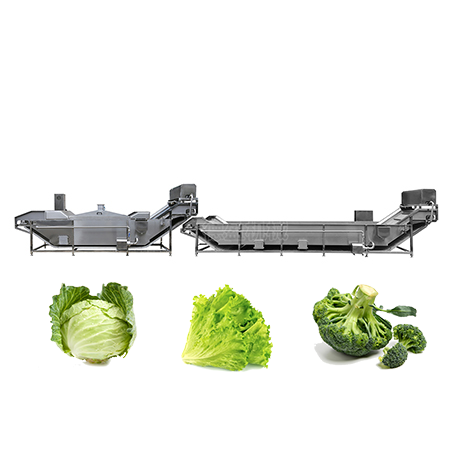
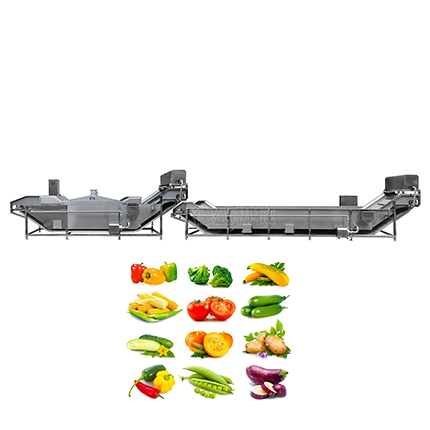
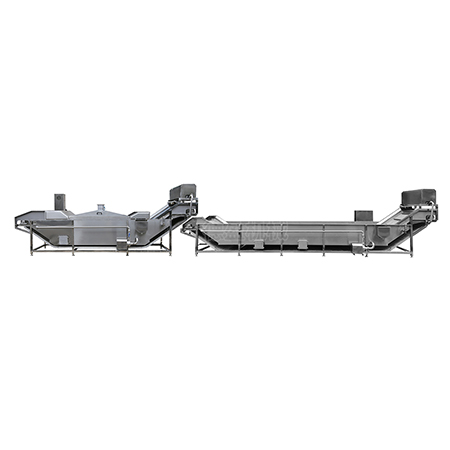
| Overall dimensions | 11000×1200×1500mm (5 meters for blanching, 6 meters for cooling) |
| Voltage | 380V |
| Power | 6.75kW |
Usage process:
1. No load test: Before starting up, check if the wiring is correct and if there are any debris in the slot. Confirm that the blanching pool, heating system, cooling system, conveyor belt and other components are intact and undamaged. Turn on the power supply of the production line, start the conveyor belt for no-load trial operation, and observe whether the equipment runs smoothly and whether there is any abnormal noise. Check the control system to ensure that all sensors and alarm systems are working properly. Only after the trial run is normal can the material be fed for processing.
2. Blanching and cooling process: The equipment adopts steam or electric heating method (customizable), and the temperature is automatically controlled. The material is fed into the blanching section through a stainless steel mesh belt and completely immersed in water for high-temperature sterilization. The common blanching temperature is 95-100 ℃, and the time is about 4-5 minutes; The sterilization temperature can be set within a certain range. After blanching, the material enters the cooling section and is quickly cooled to 2-7 ℃ using room temperature cold water or ice water to maintain the freshness and color of the product.
3. Automatic conveying: The whole machine adopts SUS304 stainless steel mesh belt or chain plate for automatic conveying. The feeding and discharging are all automatically completed by the conveying system, which is easy to operate and highly efficient. The running speed of the conveyor belt adopts variable frequency speed regulation, which can adjust the blanching time according to different materials and process requirements. The equipment is equipped with an automatic feeding and discharging system, which can smoothly connect with upstream and downstream automated production lines.
Equipment features:
The fully automatic blanching and cooling line is made of high-quality SUS304 stainless steel, with a compact structure and a hygienic and beautiful appearance. The equipment integrates blanching and cooling, achieving automatic continuous flow operation, reducing labor and improving production capacity. Equipped with an automatic temperature control device, the temperature can be automatically adjusted within 98 ℃ according to the process requirements; The conveyor belt adopts variable frequency speed regulation, which runs smoothly and has adjustable speed. The equipment is suitable for blanching, sterilizing and processing various fruits, vegetables and foods.
Feature:
Material: The whole machine is made of high-quality SUS304 stainless steel, and key components such as the tank body, frame body, chain plate, and bearing seat are all made of stainless steel, which meets food hygiene standards. The equipment runs smoothly, has low noise, is not easily deformed, and is easy to maintain.
Advanced sterilization technology: using steam or electric heating (customized), the sterilization temperature can be set within the range of 50-120 ℃. The equipment is equipped with an automatic temperature control system and temperature compensation device to ensure uniform and consistent water temperature. Adopting the pasteurization process, it effectively kills harmful bacteria and preserves the original taste and nutrition of the product.
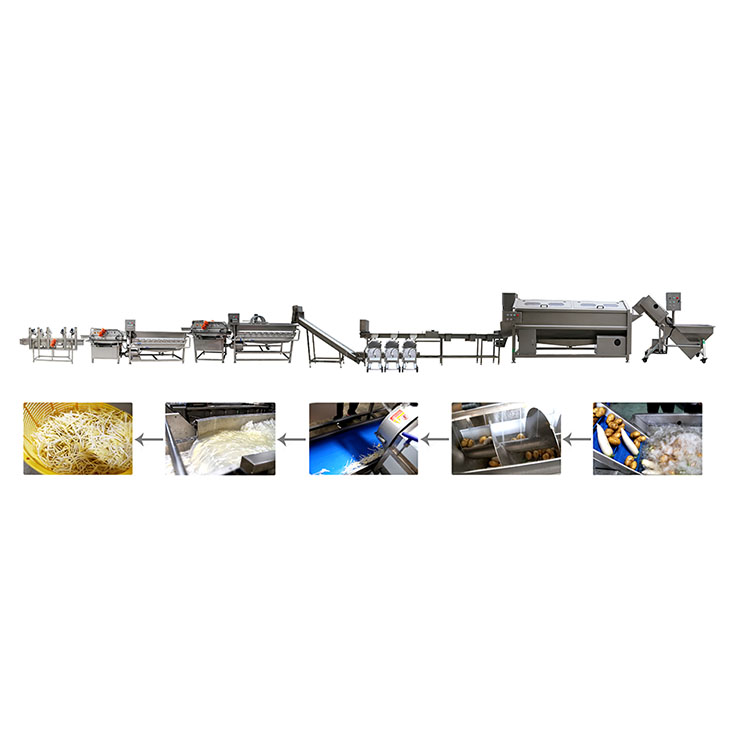
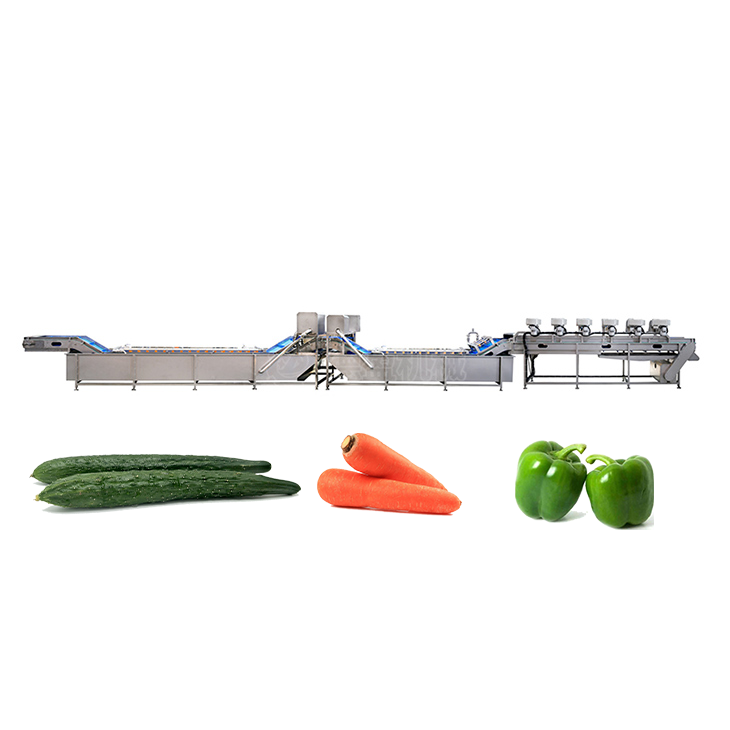
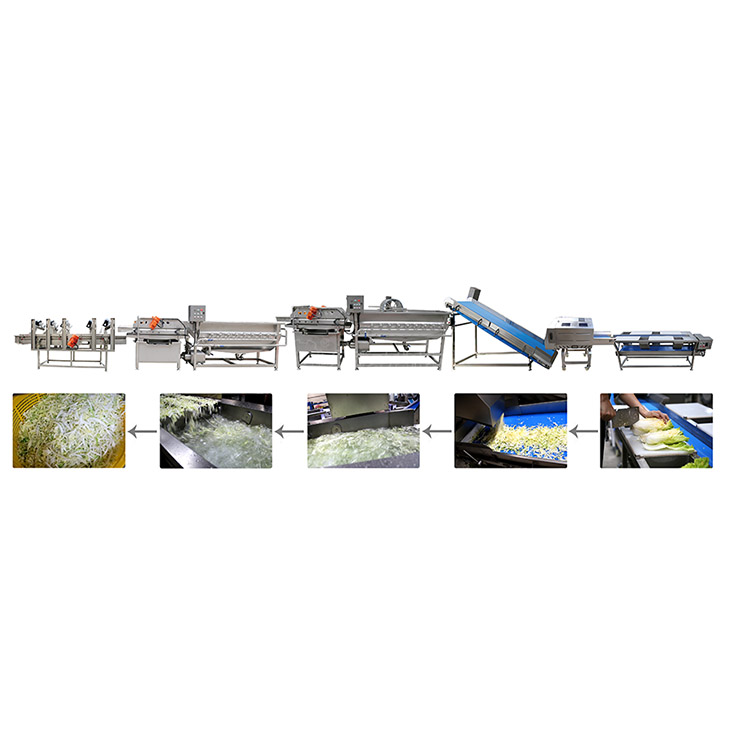
Diverse specifications: The sterilization line can be customized according to the required size. Some functions can also be added or reduced. The fully automatic blanching, scalding, cooling, and sterilization line can be connected and used together with a vegetable processing production line or a cleaning line.
Safety certification: The equipment has passed CE certification, ISO9001 certification, patent certification, etc., and is popular in various countries such as Europe, America, Asia, and Southeast Asia.
Core structure composition:
Feeding and conveying system: The material is placed on a variable speed stainless steel mesh belt and enters the blanching box in sequence under the action of the conveyor belt. There are two types of conveying methods: mesh belt conveying and chain plate conveying, and the overall material is made of SUS304 stainless steel. The running speed of the conveyor belt adopts variable frequency speed regulation to ensure that the material can be blanched in the box for a controllable time. The equipment can achieve automatic transmission of both incoming and outgoing materials.
Blanching and cooling treatment system: The equipment is divided into a blanching section and a cooling section. The blanching section completely immerses the material in high-temperature water (commonly 95-100 ℃), and the automatic temperature control system maintains even water temperature. After blanching, the material enters the cooling section through a conveyor belt and is quickly cooled to 2-7 ℃ using room temperature cold water or ice water. The cooling machine adopts an air jet rolling structure, which cools quickly and evenly.
Discharge and water circulation system: The material is automatically sent out by the conveyor belt after being blanched and cooled. The water cycle circulates from the discharge end to the feed end, making the temperature more balanced. Install a filtration system in front of the circulating water pump to prevent impurities from being pumped into the pump. The equipment is equipped with an automatic feeding and discharging system, which can smoothly connect upstream and downstream production lines.
Simplify the operational process
Before starting up, check whether there are any debris in the equipment and slot, and confirm that all components are intact. Connect the power supply, start the conveyor belt no-load test machine, and observe whether it runs smoothly. Set the blanching temperature (95-100 ℃) and conveying speed, evenly feed the material into the inlet, and automatically discharge it after blanching and cooling. Clean the equipment promptly after processing is completed.
Suitable for various processing industries
Fruit and vegetable processing industry: used for blanching and sterilization of various vegetables and fruits, such as green beans, corn, spinach, carrots, etc., by high temperature to kill surface microorganisms, maintain product color and nutrition, and provide high-quality raw materials for subsequent quick freezing, drying or canning.
Quick frozen food industry: As a key equipment for pre freezing treatment, it quickly cools the materials after blanching and enzyme inactivation treatment, effectively preventing product quality deterioration during frozen storage and ensuring the taste and flavor of frozen vegetables and fruits.
Canned products industry: Pre boil and sterilize canned raw materials such as fruits and vegetables, killing microorganisms and enzymes attached to the surface of the raw materials, creating conditions for sterilization after can sealing, and effectively extending the shelf life of canned products.
Installation and commissioning
1. Preparation before installation: Clean the installation area to ensure that the ground is flat and the load-bearing capacity is sufficient, and reserve interfaces for water, electricity, drainage, and gas sources. Open the box and inspect the equipment and accessories according to the list to confirm that there is no transportation damage. Connect the three-phase four wire system and ensure reliable grounding. Make initial adjustments to ensure smooth connection between each unit.
2. Connection inspection: Confirm that the blanching tank, heating system (steam or electric heating), cooling system, conveyor belt, and other components are intact and free from blockages or leaks. Check if all power cord connections are securely fastened, and if the power cord and steam pipeline connections are firm, to ensure reliable grounding of the equipment.
3. Debugging and trial operation: Before starting up, check whether the wiring is correct, whether there are any debris in the tank, and whether it is clean. After powering on, check if the motor is running in the correct direction. Run without load and observe whether the conveyor belt runs smoothly and does not deviate. Check the tightness of the mesh belt and confirm that all control switches and temperature gauges are normal before feeding.
Frequently Asked Questions
How to solve the problem of vegetable blanching and cooling line not heating up?
The water temperature for blanching cannot reach the set value or cannot be heated. The main reasons are that the steam valve is not open, the heating device is malfunctioning, the temperature control sensor is malfunctioning, or the heating tube is scaling. Firstly, check if the steam valve is open; Then clean the scale on the heating tube; Calibrate or replace the temperature probe.
How to solve the abnormal noise of vegetable sterilization cooling line operation?
The device emits abnormal sounds during operation. Usually caused by the conveyor belt being too loose or too tight. The solution is to adjust the tension of the mesh belt to the appropriate state through the tension switch at the feeding end of the equipment.
Maintenance method:
Daily maintenance: After daily work, the main power must be cut off and the steam valve must be closed. Drain the accumulated water in the water tank, remove impurities and residues from the conveyor belt and tank body. Rinse the tank body, heating tube, and cooling section with a high-pressure water gun and food grade cleaning agent, focusing on cleaning the mesh belt gaps and discharge ports. Check if the circulating water pump is blocked.
Weekly maintenance: Conduct comprehensive and in-depth cleaning of the equipment every week, dismantle detachable components (such as mesh belts and filters) for soaking and cleaning. Check if all connecting bolts, chains, and sprockets are loose. Check for leaks in the steam heating pipeline and clean the scale on the surface of the heating tube. Check the oil level of the gearbox and replenish lubricating oil if necessary.
Monthly maintenance: Regularly inspect all key components, including motors, reducers, bearings, temperature control systems, and electrical circuits, every month. The chain and transmission bearings need to be lubricated, and the gearbox needs to be replaced or supplemented with gear oil. Check the wear and tension of the conveyor belt, adjust or replace worn parts. Calibrate the temperature sensor to ensure precise temperature control. Check for loose and aged electrical wiring.
Safety Reminder
It is strictly prohibited to plug or unplug power plugs with wet hands; It is strictly prohibited to operate the equipment without grounding.
It is strictly prohibited to insert the body into the machine slot.
Why Choose Deying Machinery?
-Factory-Direct: Integrated manufacturing & trading for efficient, direct communication.
-Custom Solutions: Tailored processing equipment to meet your specific production needs.
-Global Network: Supported by worldwide distributors for seamless after-sales service.
-Learn more about us:https://www.dyfoodmachines.com/about-us/
| Technical Parameters | |
| Overall dimensions | 11000×1200×1500mm (5 meters for blanching, 6 meters for cooling) |
| Voltage | 380V |
| Power | 6.75kW |

Dongguan De Ying food machinery Co., LTD


Copyright © 2026 Dongguan Deying Food Machinery Co., Ltd All rights reserved.


 PDF
PDF