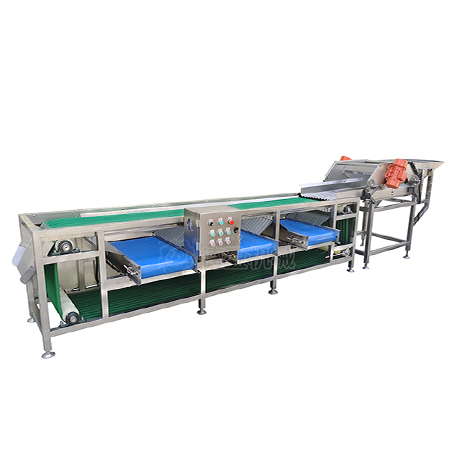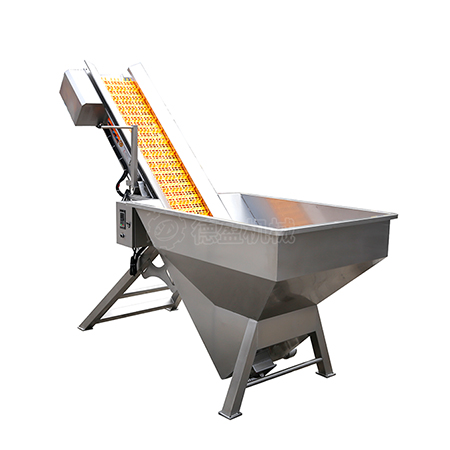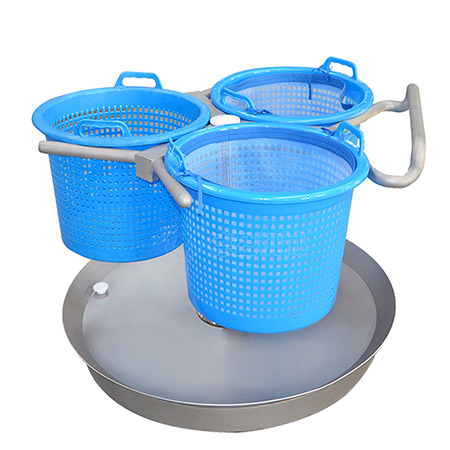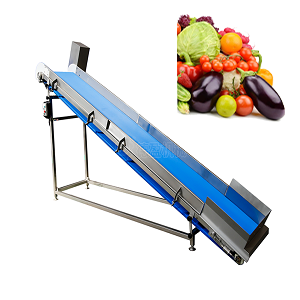
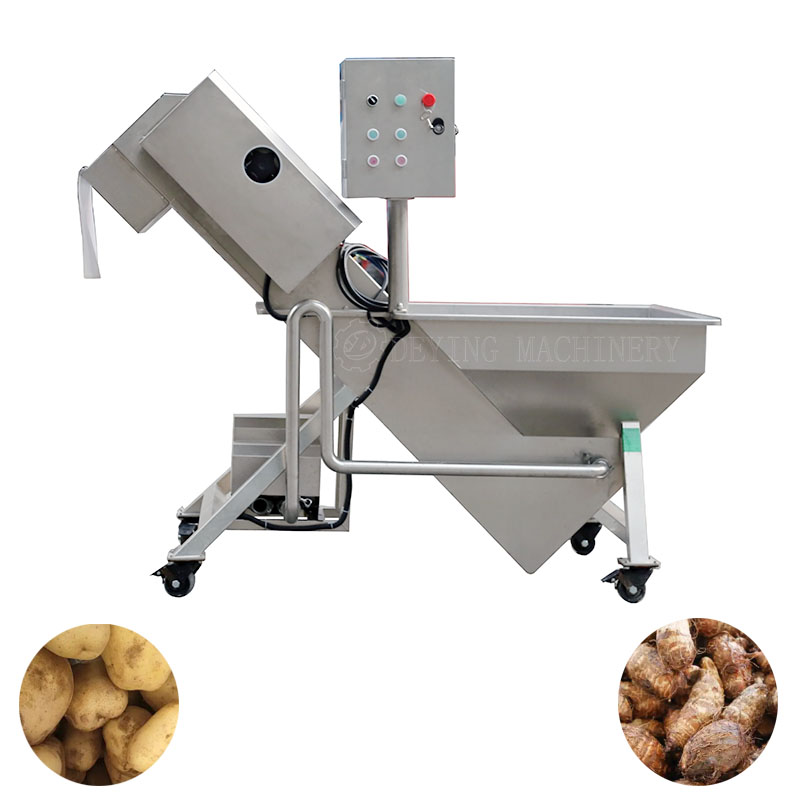






Usage: Used for lifting and conveying materials, capable of soaking materials and softening the soil on the surface of materials to a certain extent.
Features: The entire body is made of food grade 304 stainless steel material, with a water sandblasting and sandblasting texture on the surface that is easy to clean; The conveyor belt is made of food grade materials; The conveyor belt speed is adjustable.
| Technical Parameters: | |
| Overall dimensions: | 1780×880×1460mm |
| Voltage: | 380V |
| Power: | 1.1kW |
| Production: | 600-1200kg/h |
| Customization: | customizable |
Usage process:
1. Idle test run: After the entire machine is installed and moved to the preset position, all supporting wheel brakes are lowered, and the power is turned on for idle test run. Before testing, lubricating oil must be added to the gears and reducers, and the oil level should meet the specified requirements. During operation, pay attention to observing whether the chain meshes smoothly with the head and tail sprockets, whether there is any rail jamming, and whether there are any abnormalities in the components. Load testing can only be carried out after normal no-load operation.
2. Soaking and lifting: Put potatoes, taro and other materials into the soaking tank, and use bubbles to impact the sediment on the surface of the material to soften and detach it, while also allowing the material to absorb moisture and become tender. There are strip grates or sediment isolation nets in the trough to facilitate the separation of materials from water and impurities. The conveying device lifts the material from the water and smoothly lifts it along the inclined section to the discharge port, achieving the integration of soaking, cleaning, and conveying.
3. Adjustable speed: The equipment adopts a variable frequency speed regulation system, which can achieve stepless adjustment to increase the line speed. Users can flexibly choose the appropriate conveying speed on the control panel based on the characteristics of different vegetable materials. The speed regulation process is smooth and impact free, which can ensure the soaking effect of different materials and match the subsequent production rhythm, with reliable and energy-saving operation.
Equipment features:
The whole machine is made of food grade SUS304 stainless steel, which is safe and corrosion-resistant. Compact structure, adjustable tension of conveyor chain, smooth and reliable operation. The bottom of the soaking tank is equipped with a drainage outlet and a filter screen, which facilitates manual slag discharge and cleaning. Equipped with a variable frequency speed regulation system, the lifting speed can be adjusted as needed. The operation interface is simple and easy to maintain. Some models are equipped with swivel casters for flexible movement. It has the characteristics of high processing efficiency, convenient cleaning, and long service life, and is suitable for soaking and continuous production of various fruits and vegetables.
Feature:
Material: The whole machine is mainly made of food grade SUS304 stainless steel, and the side plates and brackets are sandblasted stainless steel materials, which are safe, hygienic, corrosion-resistant, and easy to clean. The conveyor belt is a food grade PVC material chain plate toothed scraper conveyor belt (can be customized according to material requirements). The overall material of the machine, as well as electronic components, motors, etc., comply with food processing hygiene standards.
Advanced soaking and lifting technology: The soaking tank is equipped with a bubble device, which generates bubbles through a high-pressure fan to impact the surface of the material, softening and separating the sediment, while making the material absorb moisture and soften. The tank is equipped with a sediment isolation net to facilitate the separation of materials from water and impurities. The feeding end of the conveying device is placed in the tank to achieve integrated soaking, cleaning, and lifting operations.
Diverse specifications: The soaking elevator offers a variety of soaking specifications and sizes, which can be customized according to needs to meet the cleaning needs of various materials.
Safety certification: The equipment has passed CE certification, ISO9001 certification, patent certification, etc., and is popular in many countries such as Europe, America, Asia, and Southeast Asia.
Universality and durability
Production capacity and matching: The soaking conveyor has a production capacity of up to 800-1200 kilograms per hour, and some customized models have a production capacity of up to 1-2 tons per hour (customized according to demand). In the processing production line, this machine is usually used in conjunction with other equipment with higher inlet heights to meet the needs of automated production.
Multi material compatibility: The equipment is suitable for processing various food materials, including root vegetables (potatoes, carrots, etc.), leafy vegetables, fruits, pickled foods, etc. Through bubble impact, the surface sediment of the material is softened and detached, while the material absorbs moisture and becomes tender. It can be used in various processes such as cleaning, pickling, bleaching, softening, etc.
Modular design: The whole machine is mainly made of SUS304 stainless steel material, and the side plates are made of food grade stainless steel plates bent and easily disassembled. The conveyor belt is a chain plate toothed scraper structure, and the entire conveying device can be removed from the immersion elevator. The equipment can be customized with different specifications according to customer needs, and can flexibly adapt to different production line layouts.
Simplify the operational process
Before operation, clean up the debris in the groove, check the oil level of the reducer, and jog to confirm that the conveyor chain plate is not stuck or lagging. Run the no-load test for 2 minutes. Put the material into the soaking tank, adjust the lifting speed according to the type of material through the variable frequency knob, and observe whether the chain plate deviates during operation. After stopping the machine, open the sewage outlet to discharge the slag, and rinse the tank and chain plate with clean water. The overall process is simple and easy to master.
Suitable for various processing industries
Fruit and vegetable processing: Used for cleaning and soaking root vegetables such as potatoes, carrots, sweet potatoes, etc., the surface sediment is removed by bubble impact, and the material absorbs moisture and tenderizes before being lifted to the peeling machine or cutting machine. It is an essential pre-treatment equipment in potato chips and clean vegetable production lines.
Production of pickles: In the processing of pickles, pickled Chinese cabbage, pickles and cucumbers, the raw materials are soaked and softened, and impurities are removed, and then promoted to the pickling can or packaging line. The stainless steel material of the equipment is salt and acid resistant, which can effectively extend its service life and ensure the hygiene and safety of pickled foods.
Canned food manufacturing: used for cleaning and pre cooking fruits such as peaches, apples, pears, as well as vegetables such as green beans and corn, to remove pesticide residues and dirt, and to enhance canning or sterilization processes, ensuring the cleanliness and taste quality of canned products.
Specialized Scenarios
Pre processing of vegetable and fruit crisps: In vacuum frying or freeze-drying production of apple slices, banana slices, taro strips, etc., soak the sliced raw materials in a color preserving solution (such as citric acid solution) to prevent browning and enhance the crispy taste. The tilt angle of the mesh belt can be adjusted to smoothly feed the soaked sheet material into the frying tank or freeze-drying bin, reducing the damage rate.
Jam processing: used for soaking, cleaning, and pre softening of strawberries, mangoes, peaches, and other fruits before pulping. The materials are sent to the pulping machine or colloid mill through a hoist. Warm water can be introduced into the groove to accelerate softening, and a large pitch scraper is used to lift the chain plate to avoid fruit pulp accumulation. The equipment output matches the capacity of the pulping machine, reducing blockage and splashing caused by manual pouring.
Frequently Asked Questions
How to solve the problem of the conveyor chain plate slipping on the soaking conveyor?
The motor is running normally but the chain plate is not moving or the speed has significantly decreased. The main reasons are insufficient chain tension, overloaded chain plates, or worn head and tail wheels. Need to adjust the tensioning device to increase the initial tension and reduce the one-time feeding amount; Check the wear of the head and tail wheels, and replace them if it is severe.
Why does the bubble elevator produce abnormal noise during operation?
The equipment emits a piercing friction sound or periodic impact sound during operation. The reasons are mostly due to bearing oil shortage and damage, chain and casing scraping or sprocket tooth wear. Need to replenish lubricating grease or replace bearings; Adjust the tension of the chain and correct the position of the sprocket.
Maintenance method:
Daily maintenance: Clean the residue and filter screen in the tank before and after each shift operation, rinse the chain plate and casing; Check the oil level and chain tension of the reducer, manually jog to confirm there is no jamming; Before leaving work, open the sewage outlet to drain the accumulated water, keep the equipment dry, and prevent rusting.
Weekly maintenance: Thoroughly clean the soaking tank and conveyor belt every week to remove sediment at the bottom; Check whether the bolts and chain connections of each bearing seat are loose, and adjust the tensioning device; Check if the motor and frequency converter cooling fan are working properly, clean the dust inside the electrical control box, and confirm that all electrical wiring terminals are not loose.
Monthly maintenance: Check the quality of the gearbox lubricating oil every month and replace it if necessary; Check the wear of the head and tail wheels, chain plates, and scrapers, and replace them promptly if they are severely worn; Verify the parameters of the frequency converter and check the clearance between the bearings of each rotating component; Perform a comprehensive tightening and lubrication of the entire machine to ensure long-term stable operation of the equipment.
Safety Reminder
During machine operation, it is strictly prohibited to reach into the cleaning tank or touch moving parts such as conveyor belts and transmission chains.
Do not leave the machine at will during operation, and pay attention to the sound and vibration of the machine for any abnormalities.
Why Choose Deying Machinery?
-Factory-Direct: Integrated manufacturing & trading for efficient, direct communication.
-Custom Solutions: Tailored processing equipment to meet your specific production needs.
-Global Network: Supported by worldwide distributors for seamless after-sales service.
-Learn more about us:https://www.dyfoodmachines.com/about-us/

Dongguan De Ying food machinery Co., LTD


Copyright © 2026 Dongguan Deying Food Machinery Co., Ltd All rights reserved.


 PDF
PDF