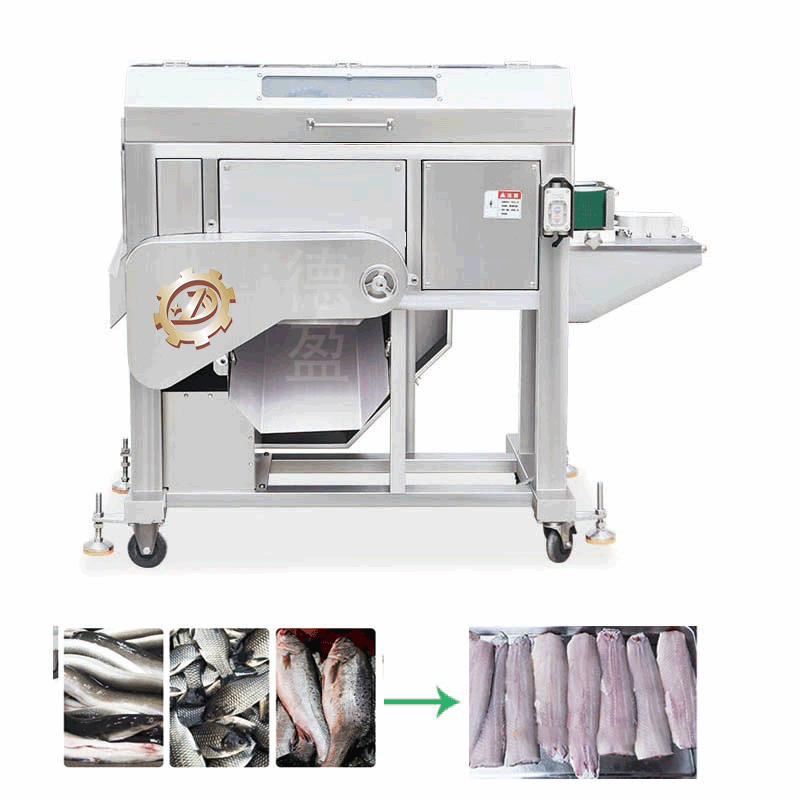
Model: [Customizable]
Voltage: 380V (Industrial Standard)
Total Motor Power: 1.9 kW
Dimensions: 1587 × 817 × 1260 mm (L × W × H)
Belt Length: 2.6 meters
Material: Full 304 Stainless Steel (Food-Grade, HACCP Compliant)
Blade Specifications:
Main Deboning Blade: 350mm × 3mm (Diameter × Thickness)
Abdominal Blade: 200mm × 3mm (Diameter × Thickness)
Efficiency: 20–40 fish/minute (Depending on fish size)
Applicable Fish Species: Snakehead , Grass Carp , Sea Bass , Qingjiang Fish , Bighead Carp , etc.
| Parameter | Detail |
|---|---|
| Power Supply | 380V 3-Phase |
| Motor Type | Brushless DC (Energy-Efficient) |
| Blade Speed | 1,200–1,500 RPM (Adjustable) |
| Noise Level | <65 db=""> |
| Weight | Approx. 380 kg |
Use process:
No-load machine test: before starting the machine every day, inch the motor and listen carefully to whether there is friction sound. In case of friction, immediately shut down the machine for inspection and adjustment. Start the machine for no-load test run after troubleshooting. Check whether the pressure of the pressure regulator is proper before startup, and normally idle for half a minute. Note that the no-load operation time should not be too long, generally not exceed 30 seconds. When the machine is shut down for a long time, it shall be started for idling for 1 minute every half month to prevent the parts from rust.
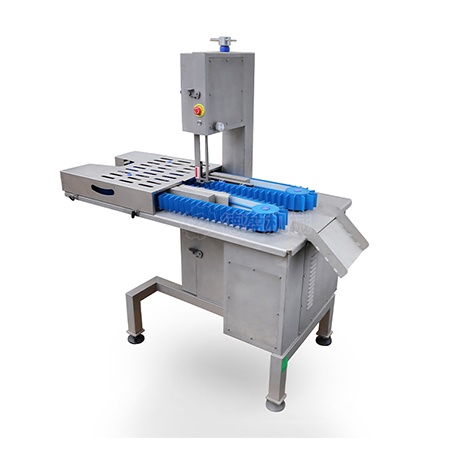
Uniform feeding: feed raw materials into the hopper immediately after the machine is started. The feeding shall be uniform and continuous. Idle operation is strictly prohibited. The feeding method adopts feeding belt and clamping flat belt, playing a stable feeding function, which is beneficial to the positive feeding of fish conveying clamp and not easy to slide. The middle part of the feed belt is designed with a V-shaped guide groove to ensure the overall effect during fish driving. If the fish is too large, cut it into small pieces or pick it up with a wooden cabinet. Raw materials must be mixed with stones, ironware and other hard sundries to avoid damaging the machine.
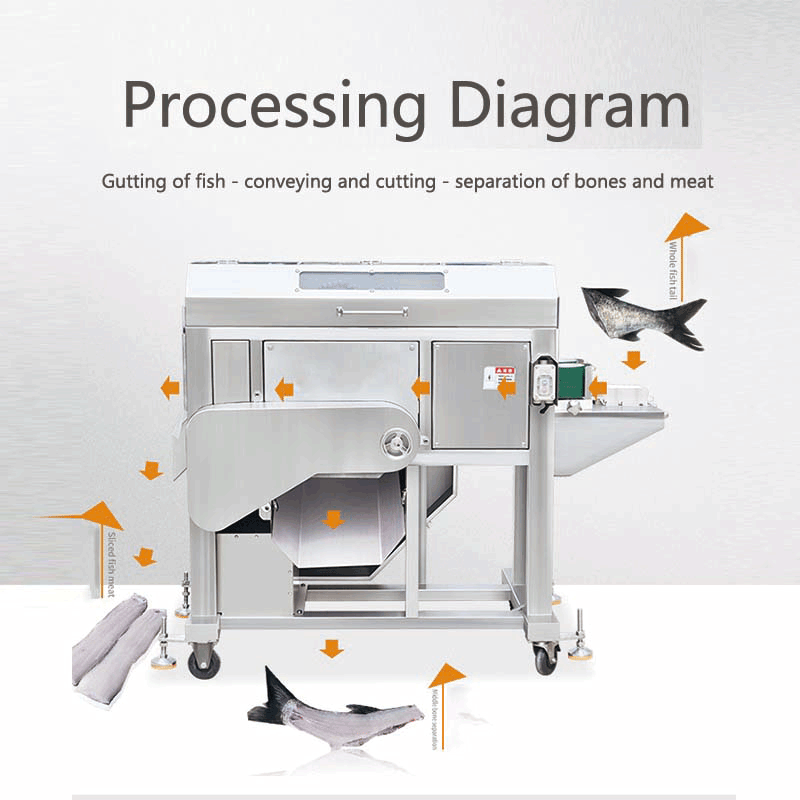
Automatic discharging: the fish body is cut into three pieces, i.e. one piece of middle bone of the fish and two pieces of fish willow, so as to completely remove the fish meat on the middle bone. Processed products are horizontally discharged from the outlet of the machine along the conveyor belt to complete automatic flow process. Fishbone ejects from the bottom of the machine. Stop the equipment after the framework in the hopper is emptied. The fish after discharging can be sent to the subsequent processing equipment such as the peeling machine via the rear conveyor.
Equipment characteristics:
The fish fragmentation bone remover is made of 304 stainless steel, which is corrosion resistant and easy to clean and complies with food hygiene standards. The feed system is designed with reverse and positive wire adjustment and V-shaped guide slot, so the feeding is stable and not easy to slide. The main and auxiliary knives are driven by the same power, matched with precise positioning conveying and arc knives, so the bone is thoroughly removed, the fish is complete and the yield is high. High production efficiency, simple operation, suitable for a variety of fish.
Features:
Material: The whole machine is made of SUS304 food grade stainless steel, and the parts contacting with food and the appearance are made of stainless steel. It has strong corrosion resistance and easy cleaning characteristics, meeting food hygiene standards. Key parts such as blades are made of special heat-treated stainless steel, and their service life is twice that of common blades.
Advanced fish bone removal technology: the intelligent positioning system is used to accurately locate the position of the fish bone through the sensor. Combined with the arc cutter and the multi-piece composite blade design, the bone apposition cutting is realized. The equipment can divide the fish body into two pieces of fish willow and one piece of middle bone at one time, and the fish meat on the middle bone can be completely removed.
Safety protection and convenience: equipped with emergency stop button, blade protective cover and other safety devices, the cutter stops immediately when the protective cover is opened. Easy to disassemble and directly flush with water; Removable parts are designed for easy cleaning and maintenance. It is easy to operate and can be directly processed by hands.
Safety certification: The equipment has passed the CE certification, ISO9001 quality management system, patents and other certification, and is popular in Europe, Europe, America, Asia, Southeast Asia and other countries.
Versatility and durability
Feeding mechanism: the feeding box adopts reverse thread and positive thread design, which can easily adjust the belt width. The feeding mode adopts one feeding belt and two clamping flat belts for stable feeding of fish, which is beneficial to the positive feeding of fish conveying clamp and not easy to slide. The middle part of the feed belt is designed with a V-shaped guide groove to ensure the overall effect during fish driving. A synchronous part is arranged on the rack to drive two clamping wheels to move close to or away from the rack synchronously, so as to keep the fish in the center all the time and avoid accidental injury caused by offset.
Cutting mechanism: the auxiliary knife is set in front of the main knife, and the auxiliary knife adjusts the position through the upper and lower adjusting rods and the left and right adjusting rods to assist the main knife in cutting. The auxiliary knife and the main knife share the same power and are driven by the chain to improve the yield of fish. The blades are designed as multiple pairs of removable structures, and the cutting blades with different functions are successively arranged along the conveying direction to realize accurate slitting. The cutting strength can be adjusted according to the size of the fish to ensure the integrity of the meat.
Modular design: the fish bone remover adopts modular design, and each functional component is relatively independent. Core components such as blades, conveying components, etc. can be quickly removed, replaced and cleaned. No special tools are required for the disassembly and assembly of the complete machine, which is easy to maintain and minimize the downtime. The modular structure facilitates flexible integration with existing production lines and can also be customized for different fish species. The equipment is compact and easy to move and deploy among different stations.
Simplified operation process
Check the blades and fasteners before startup, and test the machine with no load for half a minute after inching and hearing. Then the feeding is uniform and continuous, the equipment automatically completes the cutting, and the fishy willow and middle bone are discharged respectively. When the work is completed and the framework is emptied, shut down the machine, disassemble the blades and removable parts, wash and clean them with water, and dry them for assembly. Easy operation in the whole process, easy for novice to master.
Applicable to various processing industries
Aquatic processing plant: used for batch production of fish fillets and fillets, improving the output rate and processing efficiency, and meeting the demands of supermarkets and hypermarkets and export orders.
Frozen food enterprise: processing boneless fish block, used to produce frozen fish fillets, flavored fish fillets and other prefabricated vegetables, to ensure that the product specifications are unified.
Canned food plant: boneless and sliced raw materials such as crucian, grass carp and perch to provide clean fish meat for flavored canned food such as oil immersion and tomato juice, so as to improve the filling quality.
Installation and commissioning
Equipment installation: place the equipment on a flat and solid ground, and adjust four feet to make the whole machine stable. The professional electrician shall connect the power supply according to the rated voltage of the equipment, and the enclosure shall be reliably grounded. Install the conveyor belt and adjust the tension. Select the proper blade according to the processed fish species to ensure firm installation.
Debugging steps: check whether there are foreign matters in each fastener and hopper. Inch the motor to see if there is any friction sound. If there is any abnormality, shut down the machine immediately for troubleshooting. Carry out no-load test run for half a minute, and confirm normal operation without abnormal sound. Rotate the hand wheel to adjust the blade depth and the clearance with the conveyor belt, and adjust the clamping wheel to keep the fish centered. Feeding and trial cutting, fine adjustment to the best state according to the effect.
Frequently Asked Questions
How to solve the problem that the fish has bone or is not completely separated after being cut by the fish bone slitting machine?
Common causes are worn or improperly installed blades that need to be replaced or re-tightened. The clearance between the blade and the conveyor belt is too large, and turn the hand wheel to reduce the clearance. If the positioning device is not adjusted when the fish spec. changes, it shall be re-calibrated so that the fish is centered against the blade.
How to solve the problem of incomplete fish bone separation during fish slitting machine processing?
The common reason is that the blade position deviates or the clearance is too large. Readjust the blade depth to make it close to the spine for cutting. The feeding speed is fast and slow to maintain uniform feeding. If the size of raw fish is not adjusted timely due to large difference, the clamping wheel and blade positioning shall be synchronously adjusted according to the thickness of fish body.
Mode of maintenance:
Daily maintenance: after the work of each shift, the equipment shall be emptied and stopped. Dismantle the contact parts such as conveyer belt, blade and meat barrel, wash the residue with clean water, and do not directly wash the motor and electrical parts with high pressure water gun. Check whether the blade edge is damaged and whether the fasteners are loose. Wipe the machine body and apply food grade lubricating oil on the movable joint. Assemble and check whether it is normal during no-load operation.
Regular maintenance: weekly check the tension of transmission chain and belt, and add lubricating grease on the bearing. Check the oil level and quality of the reducer monthly, and add or replace new oil in case of insufficiency. Check the abrasion of the conveyor belt and the elasticity of the rubber belt, and replace it in case of serious abrasion. Check the electrical circuit, fasten the connecting terminal and test the effectiveness of the emergency stop safety device quarterly. It shall be operated again after being idle for more than one month to prevent corrosion of components.
Safety reminder
Do not open the cover or reach into the machine while it is operating.
In case of material jam, cut off the power first and then handle it.
Why Choose Deying Machinery?
-Factory-Direct: Integrated manufacturing & trading for efficient, direct communication.
-Custom Solutions: Tailored processing equipment to meet your specific production needs.
-Global Network: Supported by worldwide distributors for seamless after-sales service.
-Learn more about us:https://www.dyfoodmachines.com/about-us/

Dongguan De Ying food machinery Co., LTD


Copyright © 2026 Dongguan Deying Food Machinery Co., Ltd All rights reserved.