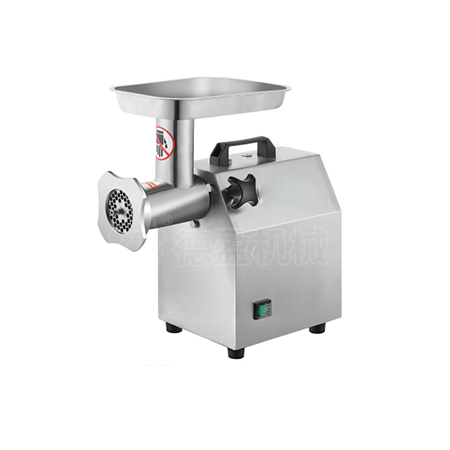
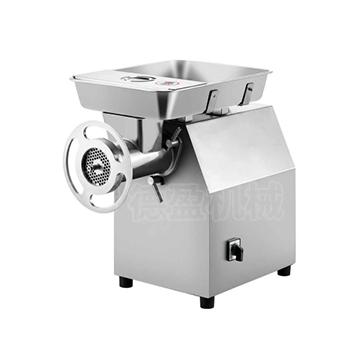






| Technical Parameters | ||||||
| Model | Power(kW) | Volt(V) | Frequency(Hz) | Efficiency(Kg/h) | N.W.(Kg) | Dimension(MM) |
| DY-80 | 0.37 | 110/220 | 50/60 | 80 | 17 | 355x 220x 435 |
| DY-120 | 0.75 | 110/220 | 50/60 | 120 | 19 | 430x230x450 |
| DY-200 | 1.1 | 110/220 | 50/60 | 200 | 22 | 455x230 x 465 |
| More models available | ||||||
Meat Grinder is a mechanical device specially used to grind whole pieces of meat or other ingredients into fine particles. It is widely used in home kitchens, catering industry, food processing plants and other fields. It pushes the raw materials to the knife disc through a spiral propulsion device, and then the high-speed rotating blade and screen cooperate to complete the cutting, and finally grind the raw materials into meat fillings or food minced with the required particle size.
According to the power source, meat grinders can be divided into manual and electric types. Electric meat grinders are more widely used, especially in commercial places. Their efficient meat grinding speed and stable performance have become one of the important equipment for meat pretreatment.
Usage process:
1. No load test machine: Before use, check whether all components are normal and clean. After connecting the power, run the machine empty for 1-2 minutes, carefully observe for any abnormal noise or friction sound, and confirm that the winch is running smoothly. When starting the switch, there should be no water in your hands, and the idle time should not be too long to prevent damage to the blades.
2. Uniform feeding: Add meat chunks after the machine is running normally. Meat needs to be boneless and skinned. Add meat chunks evenly and appropriately, and do not feed too much at once to avoid damaging the motor. When feeding meat, chopsticks or wooden sticks should be used for feeding, and direct pressing with hands is strictly prohibited.
3. Automatic discharge: The raw meat in the hopper is pushed to the pre cut orifice plate by the rotating screw, and the meat is chopped into small pieces by the shearing effect formed by the rotating cutting blade and the orifice plate eye blade. Under the continuous squeezing force of the screw, the chopped meat is automatically discharged continuously from the orifice hole. Place the receiving container below the discharge port in advance.
Equipment features:
The commercial small meat grinder adopts a stainless steel body, which has a beautiful appearance and is sturdy and durable. Its prominent feature is that the components can be easily disassembled and cleaned very conveniently. The machine has a compact structure, small size, does not take up space, and is flexible in movement. Equipped with a powerful motor, it runs smoothly and has low noise; Simultaneously designed with security protection, the operation is simple and reliable.
Feature:
Material: The whole machine is made of food grade SUS304 stainless steel, which has a beautiful appearance and meets food hygiene and safety standards. The cutter is made of high carbon chromium stainless steel casting, with high strength, high hardness, and sharp blade that does not deform.
Advanced meat grinding technology: using worm gear transmission, smooth operation and low noise. Use the rotating cutting blade and the orifice plate eye blade to form a shearing effect and chop the meat into small pieces. By cutting with a blade instead of squeezing, it effectively prevents the loss of meat juice and ensures the deliciousness of the meat.
Diversified specifications: Orifice plates can be replaced with the required size according to demand, and orifice plates can be customized according to demand. Easy to disassemble, the orifice plate can be replaced separately to change the specifications of the meat grinder.
Safety certification: The equipment has passed CE certification, ISO9001 quality management system, patents and other certifications, and is popular in Europe, Europe, America, Asia, Southeast Asia and other countries.
Universality and durability
Feeding mechanism: The feeding mechanism of commercial small meat grinders usually consists of a hopper, a feeding cage (feeding screw), and a grinding drum. After the raw meat is fed from the hopper, it is pushed forward to the meat grinding mechanism by a rotating feeding auger.
Meat grinding mechanism: The meat grinding mechanism is the core working component, mainly composed of a cutting blade and a pre cut orifice plate. During work, the meat is chopped into small pieces by relying on the rotating cutter blade and the perforated blade on the orifice plate to form a shearing effect; Under the squeezing force of the screw, the meat particles are continuously discharged from the orifice hole outside the machine. Users can replace orifice plates with different diameters according to processing requirements to produce meat pellets of different sizes.
Modular design: Commercial small meat grinders commonly adopt modular design, with each component easily detachable for easy cleaning and maintenance. The feeding module, cutting module, etc. can be quickly installed or disassembled. One machine base can be adapted to multiple orifice plate heads, achieving interchangeability of different sizes. This design not only facilitates daily cleaning and maintenance, but also facilitates quick inspection and replacement of components in case of malfunctions.
Simplify the operational process
Before operation, check that all components are installed in place and cleaned. Connect the power and conduct a no-load test for 1-2 minutes to confirm normal operation without any abnormal noise. Process boneless and skinless fresh meat or slightly frozen meat into chunks, evenly feed them into the hopper, and use wooden sticks or chopsticks to assist in pushing. It is strictly prohibited to press directly with hands. The meat is automatically discharged from the discharge port after being ground and cut, and a feeding container can be placed below. After use, turn off the power in a timely manner, disassemble the cutter, orifice plate and other components, thoroughly clean and dry them.
Suitable for various processing industries
Meat processing industry: It can be used to process sausage, ham sausage, lunch meat, Rice-meat dumplings and other products. Both fresh and slightly frozen meat can be processed, and by replacing the orifice plates with different aperture sizes, meat pellets of different thicknesses can be produced to meet the process requirements of various products.
Catering and hotel industry: widely used for kitchen preparation in restaurants and hotels. Whether it's making dumplings, filling buns, or preparing minced meat for various dishes, it can be quickly completed, making it a great helper to improve meal efficiency.
Cooked food and retail industry: commonly found in the cooked food areas or butcher shops of supermarkets and farmers' markets. We can provide on-site meat grinding services for customers, which not only ensures the freshness and hygiene of the ingredients, but also increases the flexibility of our operations.
Installation and Debugging
Equipment installation: Place the machine on a dry and ventilated horizontal table, adjust the movable anchor bolts to keep the machine level. When installing, first send the winch into the machine cavity, and drip edible oil at the shaft to reduce wear and tear; Install the cutter on the winch again, with the blade facing outward; Then install the orifice plate, and finally tighten the end cap nut with moderate tightness to prevent leakage or damage to the thread. Secure the body to the tabletop with fastening screws.
Debugging steps: Check if the power supply voltage is consistent with the nameplate to ensure reliable grounding. Before connecting the power, remove all moving parts and thoroughly clean them. Start the machine with no load, and check that the spindle rotation is counterclockwise when facing the meat grinder sleeve; If the direction is reversed, the three-phase power supply will be shut down and any two-phase live wires will be exchanged. After confirming the correct steering, stop the machine and reinstall the parts to start the feeding test.
Frequently Asked Questions
How to solve the problem of poor meat production or paste formation during the processing of commercial small meat grinders?
The common reason is that the front nut is too loose, causing poor contact between the cutter and the orifice plate, and the tightness should be readjusted. Blockage of the orifice plate or reverse installation of the cutter (the blade is not tightly attached to the orifice plate) can also cause this problem, and it needs to be cleaned or installed correctly. When the blade is passivated, it needs to be ground or replaced.
How to solve the problem of abnormal vibration or loud noise during the operation of a small meat grinder?
The meat grinder blade holder is not installed properly and should be reassembled according to the instructions. The machine should be placed on an unstable table and moved to a stable location for fixation. If adding too much material causes the tool holder to get stuck, the excess material needs to be removed.
Maintenance method:
Daily maintenance: After each use, immediately shut down the machine and cut off the power, and remove the screws, orifice plates, and other components. Rinse with warm water and food grade cleaning agent to thoroughly remove residual meat and oil film. After washing, air dry or wipe dry to prevent rusting. Wipe the surface of the machine with a damp cloth and do not rinse the main unit with water. Check whether the blade edge has become dull or broken, and deal with it in a timely manner.
Weekly maintenance: Thoroughly clean the entire machine every week, taking care not to rinse the equipment with water to prevent water from entering electrical appliances or transmission bearings. Tighten all screws and anchor bolts. Check the tightness of the belt and adjust the tension if necessary. Clean the dead corners inside the auger cavity. Check the tightness of the transmission chain and replenish or replace the lubricating oil.
Monthly maintenance: Conduct a comprehensive inspection of the motor's operating status every month, measure vibration values and noise for any abnormalities. Disassemble and inspect the winch bearings, clean and refill with lubricating grease. Check for oil leakage in the seals (oil seals) and replace them promptly. Check the oil level and quality of the gearbox. If the oil color becomes dark or contains impurities, it needs to be replaced with new oil. Check the insulation condition of the motor.
Safety Reminder
Do not open the cover or reach inside the machine during operation.
If there is a jamming, power off first and then handle it.
Why Choose Deying Machinery?
-Factory-Direct: Integrated manufacturing & trading for efficient, direct communication.
-Custom Solutions: Tailored processing equipment to meet your specific production needs.
-Global Network: Supported by worldwide distributors for seamless after-sales service.
-Learn more about us:https://www.dyfoodmachines.com/about-us/

Dongguan De Ying food machinery Co., LTD


Copyright © 2026 Dongguan Deying Food Machinery Co., Ltd All rights reserved.


 PDF
PDF