





Onion peeling machines are widely used in food processing plants, catering industries, supermarkets and markets, agricultural product processing centers and frozen food production. In food processing plants, it improves production efficiency and meets the production needs of onion powder, onion slices, onion sauce and other products; in the catering industry and central kitchens, it greatly reduces manual peeling time and improves work efficiency; in supermarkets and markets, it is used for pre-preparation Process onions for sale and provide convenient pre-processed products; in agricultural product processing centers, increase onion processing speed, reduce labor costs, and ensure product quality consistency; in frozen food production, ensure the high quality and hygienic standards of frozen onion products. These application fields all take advantage of the onion peeling machine's high efficiency, speed, and hygienic characteristics to significantly improve peeling efficiency and quality and meet production requirements of different scales and needs.
| Technical Parameters: | |
| Overall dimensions: | 2000*740*1500 |
| Voltage: | 380V |
| Power: | 1kW |
| Production: | 500-800kg/h |
| Customization: | customizable |
Use process:
No-load test run: switch on 380V power supply (voltage can be customized according to requirements) to start the equipment and let the machine idle for 1-3 minutes. Carefully check whether the running direction of the chain conveyor is consistent with the machine mark, and confirm that the spiral roller and other parts operate stably without abnormal noise or clamping stagnation. No-load test is a necessary step to ensure coordinated operation of all transmission parts and avoid faults during operation with materials.
Uniform feeding: the onions are manually cut at the head and tail and then put into the conveyor belt, which will be sent to the chain type automatic feeder to continuously and stably feed into the peeling device. Based on the freshness of onions, adjust the feeding speed through the control panel to ensure that the onions are evenly spaced and in the same direction. Uniform feeding is the key to ensure stable peeling quality and avoid blocking or idling.
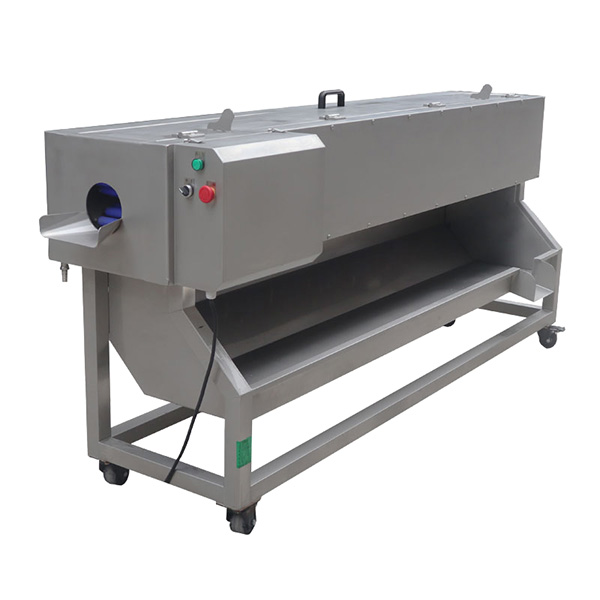
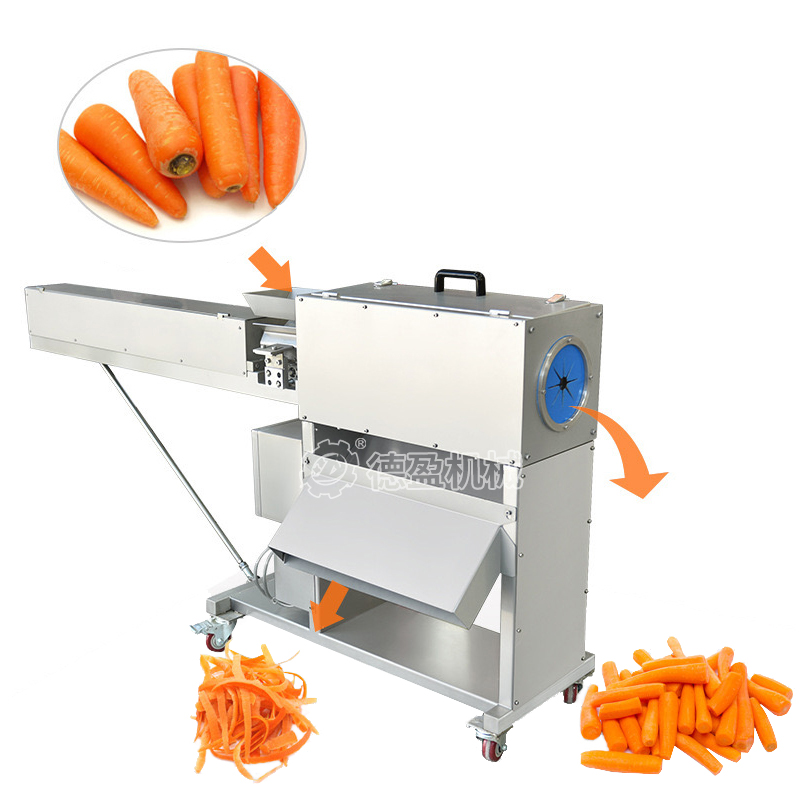
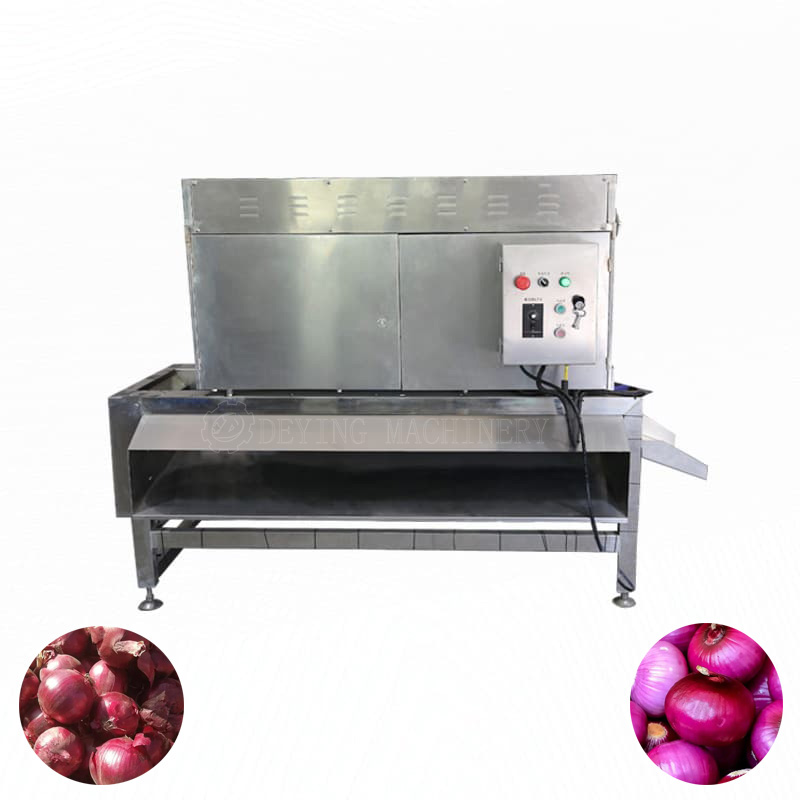
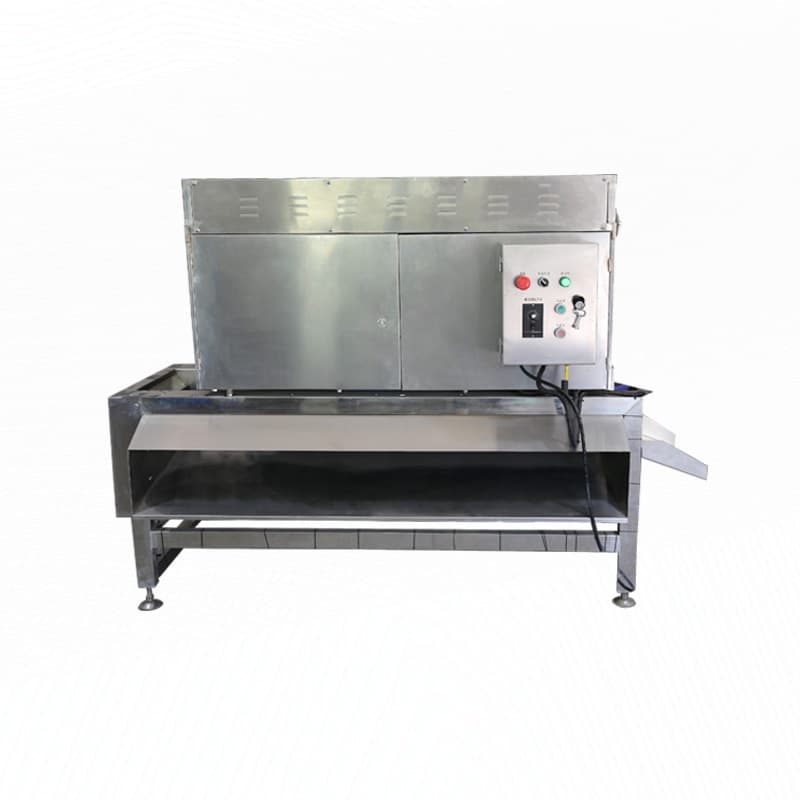
Automatic Discharging: The scalloped and barbed onions are fed to the spiral peeler. The unit consists of four co-rotating helical rollers on which the onions roll and move forward. At the same time, the high pressure air nozzle at the top ejects a strong airflow and blows off the onion skin. The stripped onions are automatically pushed out from the discharge port, and the peeled scallion skin is blown to the waste chute below by the wind, so as to realize automatic separation of onions and scallion skin.
Equipment characteristics:
The combination of spiral peeling device and high pressure air flow is adopted for the onion peeling machine to realize efficient and nondestructive peeling, with peeling rate up to 98% and bruise rate lower than 5%; The equipment operates automatically, can continuously and evenly feed and automatically separate scallion skin and scallion meat without manual intervention; The machine body is made of food grade 304 stainless steel, complying with hygiene standards and eliminating potential pollution hazards; Easy operation, low energy consumption, high capacity, significant labor cost saving, suitable for large-scale processing and production.
Features:
Material: the body of the onion peeling machine and the part contacting with food are made of food grade stainless steel, with strong abrasion resistance, corrosion resistance, non-toxic and harmless for long-term operation, meeting the requirements of food processing machinery hygiene standards. Durable, nonstaining, easy to clean and maintain.
Advanced decrustation technology: the advanced technology combining spiral decrustation device and high pressure air flow is adopted. Four spiral rollers rotate in the same direction to roll the onions and move forward. Meanwhile, the high pressure air nozzle at the top ejects strong air to quickly peel off the onion skin. The peeling process does not rub with the blade and hard objects, and the peeling rate is up to 98% and above, and does not damage the edible layer inside the onions.
Safety protection and convenience: the machine is equipped with a safety protection cover to effectively avoid personal injury during operation. The equipment adopts automatic digital control, which is simple and convenient to operate, and the onions and scallion skin are automatically separated. Electrical components shall be well packaged without leakage, with reasonable overall design and safe and reliable use.
Safety certification: The equipment has passed the CE, ISO9001 quality management system certification and patent certification, and is popular in Europe, Europe, America, Southeast Asia and Asia.
Versatility and durability
Processing structure (core): the core processing mechanism adopts three spiral rollers rotating in the same direction, the bearings at both ends are fixed on the frame, and the shaft head at one end is sleeved with gear, which is driven by the motor through the chain. The roller body spiral is provided with arc teeth. After the onions enter from the feed inlet, they roll on the four spiral rollers and move forward. At the same time, the top high pressure air duct ejects strong air to quickly peel off the onions skin. Part of the stripping assembly consists of two stripping rollers and two spiral conveying rollers, which are arranged side by side. The entire process is free of blade friction and damages to the edible layer inside the onions.
Drive and feed/discharge mechanism: PVC conveyor belt is adopted for automatic feeding, which can continuously convey 20-120mm diameter onions in flowing water. The conveying mechanism comprises a chain transmission mechanism and four equidistant roller shafts. A roller is sleeved on the roller shaft, and a rolling mechanism is arranged on the side of the roller to drive the roller to rotate around the roller shaft, and the rotation direction on the upper side of the roller is opposite to the conveying direction of the roller shaft. When discharging, the stripped onions will fall into the material receiving box automatically through the chain. The motor transmits the power to each mechanism through chain, gear and other components.
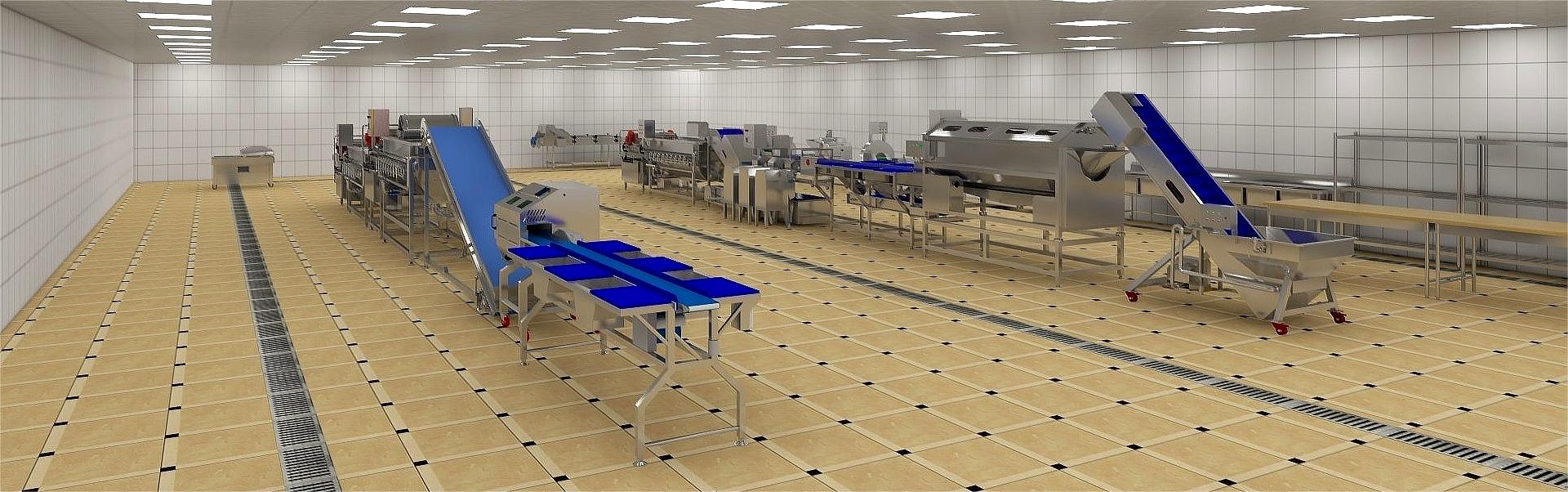
Modular design: the whole machine adopts the modular design concept, and the main components are independent modules, with simple structure, which can be dismantled, replaced and cleaned separately. The modular design supports flexible configuration, and the equipment layout can be quickly adjusted according to the production requirements to adapt to the production lines of different scales. Each functional unit of the equipment (feeding, peeling, discharging, etc.) can be independently maintained, and can be quickly disassembled without special tools, so as to facilitate batch conversion and daily cleaning. The modular structure is also helpful for later expansion. It can seamlessly integrate cutting, packaging and other components to form a complete processing flow.
Simplified operation process
The operation process of the equipment is extremely simplified: no-load test run shall be carried out after the power is connected to confirm that the spiral roller and conveyor belt operate normally; Then adjust the feeding speed according to the size of onions, put the onions into the feed hopper, and the automatic conveyor belt will uniformly send them into the spiral peeling area; The equipment automatically completes tumbling, high-pressure air blowing and scallion skin separation. The stripped onions are pushed out from the outlet, and the waste skin will automatically fall into the waste tank below; Continuous production can be achieved by simply monitoring the operating conditions and cleaning the waste chutes regularly.
Applicable to various processing industries
Food processing plant: the full-automatic onion peeler can be seamlessly integrated into the deep processing line of onions for the production of clean vegetables, dehydrated vegetables, etc. Its high efficiency peeling capacity can significantly improve the efficiency of pretreatment.
Catering and large chain restaurants: widely used in large canteens, restaurants, hotels, etc. The equipment is easy to operate and can quickly handle a large number of onions, effectively reducing labor costs and operating risks.
Agricultural product processing and clean vegetables distribution center: the equipment can be seamlessly integrated into the clean vegetables processing production line, and used in schools, troops, enterprise canteens, agricultural markets and other group food distribution enterprises and central kitchens. The processing capacity per hour can reach 1-3 tons, which is 10 times more efficient than manual peeling. The stripped onions are smooth and free of damage, providing convenience for subsequent distribution and cooking.
Installation and commissioning
The onion peeler shall be placed on a flat and firm ground. Sufficient operation space shall be reserved at the installation position for daily maintenance and cleaning. The electrical connection must be operated by the professional electrician to confirm that the power voltage conforms to the equipment regulations (the voltage is customized according to the local voltage), the power wiring is firm and reliable, and the socket is equipped with reliable grounding protection. No special anti-corrosion treatment is required for the stainless steel of the complete machine.
Garlic and fermentation products: press the "start" button after power on, observe whether the running direction of the chain conveyor is consistent with the machine mark, and immediately adjust if the direction is not correct. Then carry out no-load test run, let the machine idle for 1-3 minutes, and carefully check whether the spiral roller and other parts operate stably, whether there is abnormal noise or clamping stagnation. When the no-load operation is normal, adjust the feeding speed according to the size and variety of onions, and feed for production after confirmation.
Frequently Asked Questions
How to solve the problem of uneven peeling of equipment and residual skin of some onions?
The rubbing force may be reduced due to wear on the screw roll surface, or the high pressure air flow pressure may be insufficient, the nozzle may be blocked, or the feeding speed may be too fast to allow the onions to stay on the roll for too long. Regularly check the wear of the curved teeth of the spiral roller and replace the worn parts in time; Clean the nozzle and adjust the air pressure to a proper range; Properly reduce the feeding speed to ensure that the onions are fully rolled and winded.
The damage rate of onions is high when peeling. How to solve the crack or crush damage?
Usually, excessive rubbing is caused by too high air pressure or too small space between spiral rollers; Uneven feed causes onions to squeeze each other. The air pressure shall be properly reduced according to the hardness and size of onions, and properly increased if the roller spacing is adjustable; Ensure uniform feeding, avoid accumulation, and check whether there is burr on the surface of spiral roller.
Mode of maintenance:
Daily maintenance: the complete machine must be thoroughly cleaned after daily use, with focus on cleaning the remaining onion skin and debris on the surface of the spiral roller, the conveyor belt and the waste outlet, so as to prevent the debris accumulation from affecting the operation. Check whether the rotating parts (such as chain and gear) are normal and whether there is abnormal sound or looseness. Conduct no-load test run for 1-3 minutes before each startup, and observe whether the equipment operates stably.
Regular maintenance: check and clean all parts at least twice a week, including lubrication of chain transmission mechanism and maintenance of screw roller bearing. Check the abrasion degree of the arc teeth of the spiral roll every month, and replace in time in case of serious abrasion; Replace the transmission gearbox lubricating oil. Regularly check all fastening bolts for looseness, conveyor belt for proper tension and pneumatic components (solenoid valve and filter) for normal operation. Thoroughly clean and apply anti-rust oil before long-term shutdown.
Safety reminder
Do not open the cover or reach into the machine while it is operating.
In case of material jam, cut off the power first and then handle it.
Why Choose Deying Machinery?
-Factory-Direct: Integrated manufacturing & trading for efficient, direct communication.
-Custom Solutions: Tailored processing equipment to meet your specific production needs.
-Global Network: Supported by worldwide distributors for seamless after-sales service.
-Learn more about us:https://www.dyfoodmachines.com/about-us/

Dongguan De Ying food machinery Co., LTD


Copyright © 2026 Dongguan Deying Food Machinery Co., Ltd All rights reserved.